Chinese forms the second largest group of Sarawak's population after the main
Iban tribe.
In Kuching
Main Bazaar, opposite the Waterfront, is the
oldest street in the city and the heart of old Kuching. It has some superb
examples of Chinese shophouse architecture, many of which have been occupied by
the same family for generations. These families still pursue traditional occupations
such as tin-smithing, carpentry and petty trading. Kuching’s highest
concentration of antique and handicraft shops are to be found here, and
shoppers can rest between bargaining sessions in a number of old-fashioned
coffee shops with panelled walls and marble-topped tables.
 |
| Main Bazaar |
Carpenter Street, parallel to Main Bazaar, has a similar selection of small
traders and coffee shops, as well as food stalls and two small Chinese temples.
The whole area oozes charm and character. Off Leboh China (Upper China St.) there is a row of
perfectly preserved 19th century Chinese houses.
 |
| Carpenter Street |
 |
| Guan Thian Siang Ti Temple |
 |
| Kueh Seng Onn Temple |
The ornately decorated Tua Pek Kong Temple is
located on Jalan Tunku Abdul Rahman, opposite the Waterfront, and is the oldest
Chinese temple in Kuching. It is believed to date from 1843, although official
records only recognize its existence since 1876. The Wang Kang festival to
commemorate the dead is held here.
 |
| Tua Pek Kong Temple |
The Chinese History Museum
is situated on the Waterfront opposite the Tua Pek Kong temple. It traces the
history of the Chinese community in Sarawak.
Exhibits include the early trade routes, initial migration from various regions
of China, geographical
distribution, the early pioneers, traditional trading activities, the formation
of trade and community associations, political history and the involvement of
the Chinese community in modern, multi-racial Sarawak.
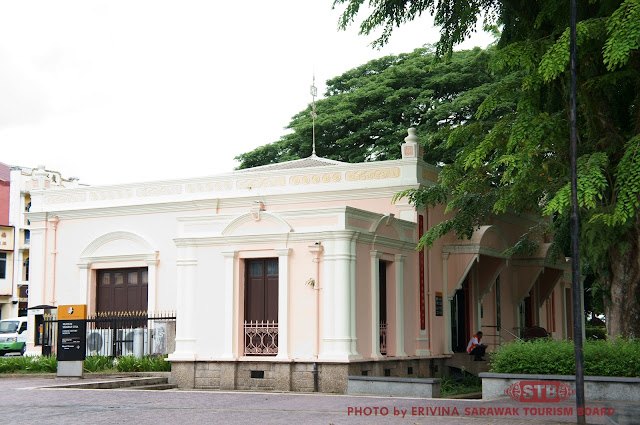 |
| Chinese History Museum |
Jalan Padungan is lined with Chinese shophouses, mostly built in the 1920’s and
30’s during the rubber boom. Some are very elegantly decorated, and a walk
round the back of the buildings can reveal fascinating architectural details.
The area has some excellent coffee shops and restaurants, more handicraft shops
and some unusual specialist retailers. The Great Cat of Kuching, a monumental
kitsch statue, is situated at the junction of Jln Padungan and Jln Central. It celebrates the major festive seasons of the various ethnic group by wearing their traditional costume; a pet (
pun intended) project of Kuching City South Council
 |
| Jalan Padungan |
In Sibu
The residents of Sibu
are predominantly Foochow Chinese, originating from the Fuzhou
region of southern China,
and the town is often referred to as New Fuzhou.
Sibu’s transformation
began in 1901 with the arrival of Foochow settlers from southern China, led by
the Reverend Wong Nai Siong. Rev. Wong was a Methodist missionary who sought to
find a safe haven for his followers, who were subject to religious persecution
in China.
Rev. Wong petitioned Charles Brooke, the second White Rajah of Sarawak, who
gladly offered land in the Lower Rejang area in order to develop Sarawak’s agriculture. The first batch of 72 pioneers
arrived in 1901, and by 1903 over 1,000 Christian Foochow had made their homes
in Sibu. They were later followed by a sizable group of Henghuas and Cantonese
during the 1st World War period.
 |
| Wong Nai Siong Memorial Garden |
The early Chinese settlers planned to cultivate rice, but
soon found that the soil was unsuitable for profitable rice farming and turned
their attention to pepper, rubber and gambier (a sticky resin formerly used in
place of rubber).
Tua Pek Kong Temple & Goddess of Mercy Pagoda, the 100-year
old Tua Pek Kong Temple (Jln
Temple) is the oldest and
best preserved Chinese temple in Sibu. The
adjacent 7-storey Goddess of Mercy (Kuan Yin) Pagoda was added in 1987, and is
said to be one of the most perfectly proportioned pagodas outside Mainland China.
 |
| Sibu Tua Pek Kong Temple & Goddess of Mercy Pagoda |
Sungai Merah Heritage Walk, the site of the earliest Chinese settlements in Sibu,
Sungai Merah (Red River) is an old bazaar
about 10 minutes by road from the town centre. The area has recently been
restored and landscaped, with a pleasant walking trail along the river front
(the water really is red, changing occasionally to yellow!) which leads through
a quaintly landscaped park to the
Wong
Nai Siong Memorial Garden (see pic), erected in honour of the town’s
principal founder and featuring a bronze statue of the missionary leader.
 |
| Sungai Merah Heritage Walk |
The
Yu Lun San Tien En Si (Jade Dragon Temple) at the Sibu-Bintulu road is believed to be the largest temple complex not only in Malaysia
but in South East Asia as well. It is a religious place
for Buddhism, Taoism and Confucianism and is known for bringing all 3
different forms of practice under one roof.
There are a number of potteries around Sibu which produce
excellent quality wares in traditional Teochew Chinese styles, albeit with
strong local influences.
 |
| Traditional Teochew styles potteries in Sibu |
In Miri
Chinese labourers came to Miri to work in the coalmines and oilfields. These labourers
were mainly Hakka and Cantonese, with a smaller number of Teochews and
Hainanese.
Miri Old Town is a narrow warren of streets
crammed with tiny shops selling a huge variety of goods, from Chinese funeral
supplies to hi-tech electronics, as well as some of the most traditional and
original coffee shops in town. The Old
Town is gradually being
renovated, street-by-street, but the architectural style and layout is being
carefully preserved.
Tua Pek Kong temple at Jalan Bendahara is dedicated to the deity most beloved by
overseas Chinese. According to local legend, work started in the temple in
1913, in order to give thanks to the deity for helping to end a mysterious
epidemic.
 |
| Miri Tua Pek Kong temple |
The San Ching Tian temple (Jalan Krokop 9) is the largest Taoist temple in Southeast Asia. The superb red roof, elegant lotus design motifs and the delightful wind chimes make this a very impressive place to visit.
 |
| Miri San Ching Tian Taoist temple |
Till today the Sarawak Chinese still maintain their heritage and culture, celebrating all the major cultural
festivals, such as the Chinese New Year and the Hungry
Ghost Festival. You can witness all these wonderful happenings here in
Sarawak... where adventure lives.
 |
| Mooncake Festival at Carpenter Street Kuching |
By: Erivina Jihel
Sarawak Tourism Board


